


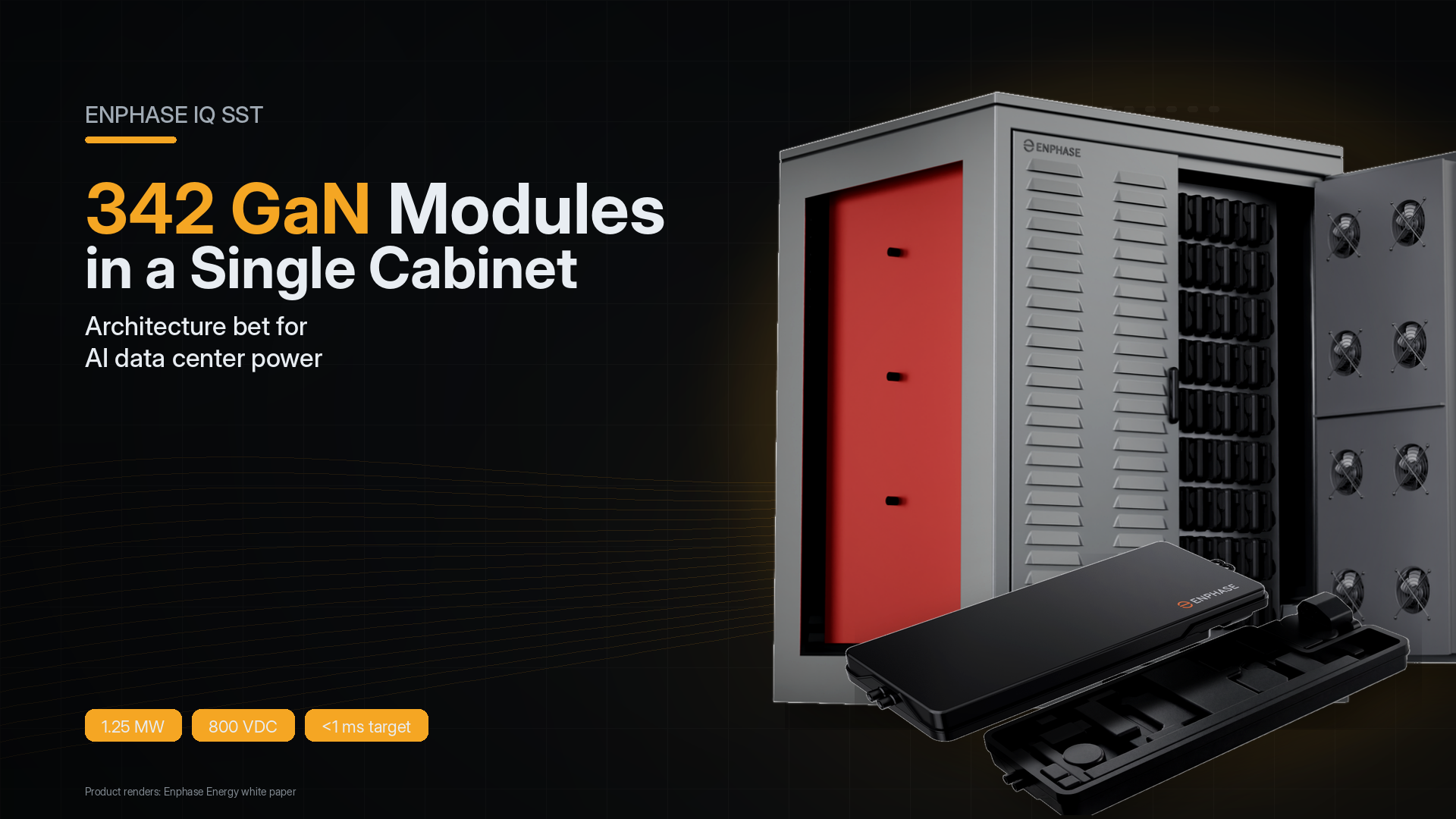
Enphase just published the most detailed product-level SST disclosure the power electronics industry has seen. The core claim: control response speed — not rated efficiency, not power density — should be the primary design constraint for AI data center solid-state transformers.
That’s a specific, falsifiable architectural judgment. And everything in the 19-page white paper — the module count, the device choice, the topology — follows from it.
Why speed matters more than efficiency here
AI data center loads swing violently. 10%–100% fluctuation, multiple times per second. NVIDIA’s GPU rack roadmap makes this worse with each generation: Rubin Ultra NVL576 (mid-2027) pushes past 600 kW per rack. Feynman (2028) exceeds 1 MW.
At those densities, traditional power supply units can’t physically fit inside compute racks. NVIDIA and OCP’s Diablo 400 specification both point toward sidecar power racks — dedicated cabinets packed with PSUs, battery backup units, and capacitor banks. By Feynman’s >1 MW level, those sidecars will be completely full.
Enphase’s argument: if an SST can respond fast enough — the white paper targets <1 ms, roughly 1,000x faster than conventional approaches — local energy buffers become unnecessary. Backup shifts to remote battery energy storage systems. The sidecar rack empties out. Same server room footprint, theoretically double the AI compute capacity.
The module math behind 342
Most SST competitors lean toward fewer, larger modules built around high-voltage SiC switches. Fewer modules mean simpler synchronization. Enphase went the opposite direction.
Their logic chain: smaller modules → smaller inductors → higher switching frequency → wider control bandwidth (the white paper claims >10 kHz). Wider bandwidth is what delivers <1 ms response. You can’t get there with a handful of large modules switching at lower frequencies — the physics won’t cooperate.
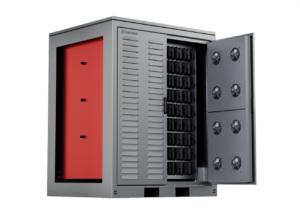
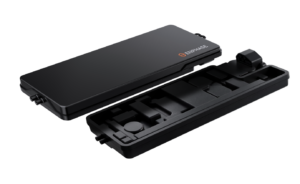
The IQ SST packs 342 power modules into a single 1.25 MW cabinet. In a 34.5 kV configuration, that’s 3×114 modules in a delta connection. Each module runs on GaN bidirectional switches and a fifth-generation custom ASIC called Kestrel — the same control silicon Enphase uses in its microinverters, adapted with a tandem fiber-optic link to bridge the medium-voltage isolation barrier.
Enphase accepts the complexity of synchronizing 342 modules because it believes the response speed advantage of small, high-frequency modules is a harder physics limit to work around than distributed control.
GaN over SiC: The supply chain logic
The device choice reinforces the architecture. GaN HEMTs are low-voltage rated, widely available, and suited to high-frequency switching. High-voltage SiC devices serve the competing large-module approach.
There’s a cost angle too. Enphase’s PCIM 2025 keynote and Infineon’s November 2025 announcement on CoolGaN BDS technology for the IQ9 microinverter both point to up to 4x cost advantage for GaN bidirectional switches over conventional unidirectional devices. That’s a device-level number — system-level cost depends on drivers, protection, thermal management, and integration. Still, 342 modules per cabinet at volume would represent one of the largest single GaN demand pulls in data center power.
What Enphase brings — and what remains unproven
Enphase frames IQ SST as mature manufacturing capability extended. The numbers behind that claim: approximately 87.8 million microinverters shipped, >30 GW deployed, 500 DPPM reliability target, 25-year warranty track record. U.S. manufacturing infrastructure carries additional weight in the current geopolitical environment.
The Kestrel ASIC inherits the full Advanced Grid Functions library from Enphase’s microinverter platform — IEEE 1547 and UL 1741 SB compliance built in. For data center operators navigating grid interconnection approvals, that removes one qualification layer.
But the gap between kW-scale microinverters and a MW-scale SST is not linear.
Every headline specification in the white paper — <1 ms response, 99.999% availability, 1,000x buffer reduction — is a design target. No third-party test data exists. The white paper’s Safe Harbor statement says as much.
342 modules operating in coordinated medium-voltage conversion introduce synchronization, protection coordination, thermal management, EMC, and insulation aging challenges that microinverter field data simply doesn’t address. The 10% module redundancy and 10-year warranty projections extrapolate from outdoor solar duty cycles — intermittent operation, thermal cycling — which differ substantially from continuous full-load data center service.
And the commercialization timeline is blank. No production date. No pilot customer named. Against NVIDIA’s Rubin Ultra window in mid-2027, Enphase needs full-system validation and customer engagement within 12–18 months. For a company that has never shipped a MW-class product, that schedule is aggressive.
What to track in the next 12–18 months
Three milestones will separate architectural thesis from commercial reality.
A full-system demonstration — at what scale, and when. A single-module or partial-rack demo is not the same as 342 modules running synchronized at 34.5 kV.
A named pilot customer. Data center operators evaluate suppliers across system integration capability, service networks, financial guarantees, and reference deployments. Manufacturing heritage alone doesn’t close that gap.
Independent verification of the <1 ms response and 99.999% availability claims. Until a third party measures these under realistic load conditions, they remain engineering projections.
Enphase published the most complete product-level SST technical disclosure available in the public domain. The architecture logic holds together. Whether the engineering and commercial execution can match on the timeline the market demands — that’s still an open variable.
Sources:
- IQ Solid-State Transformer: Intelligent Power for AI — White Paper, Enphase Energy, April 2026
- Enphase Energy Publishes Technical White Paper on IQ SST Architecture, Enphase Energy, May 4, 2026
- NVIDIA 800 VDC Architecture Will Power the Next Generation of AI Factories, NVIDIA Technical Blog
- Nvidia’s Rubin Ultra NVL576 rack expected to be 600kW, Data Center Dynamics
- OCP Diablo 400 Specification v0.5.2, Open Compute Project, May 2025
- Monolithically Integrated GaN HEMT Bi-Directional Switch — PCIM 2025 Keynote, Michael Harrison, Enphase Energy
- Infineon GaN Technology Powers Enphase IQ9 Microinverters, Infineon Technologies, November 2025