
I was in Shanghai on June 30 for Infineon’s 2026 Media Day, held at the company’s Greater China headquarters in Zhangjiang under the theme “From Innovation to Value.” Infineon’s Greater China leadership — including David Poon, global senior vice president and Greater China president, and Cao Yanfei, senior vice president and head of the automotive business in Greater China — walked the room through the company’s overall strategy and localization plan, then through the automotive, industrial and infrastructure, and consumer, computing and communications businesses in turn. A few years ago, the power discussion around AI infrastructure could still be overshadowed by the GPU discussion. That is getting harder.
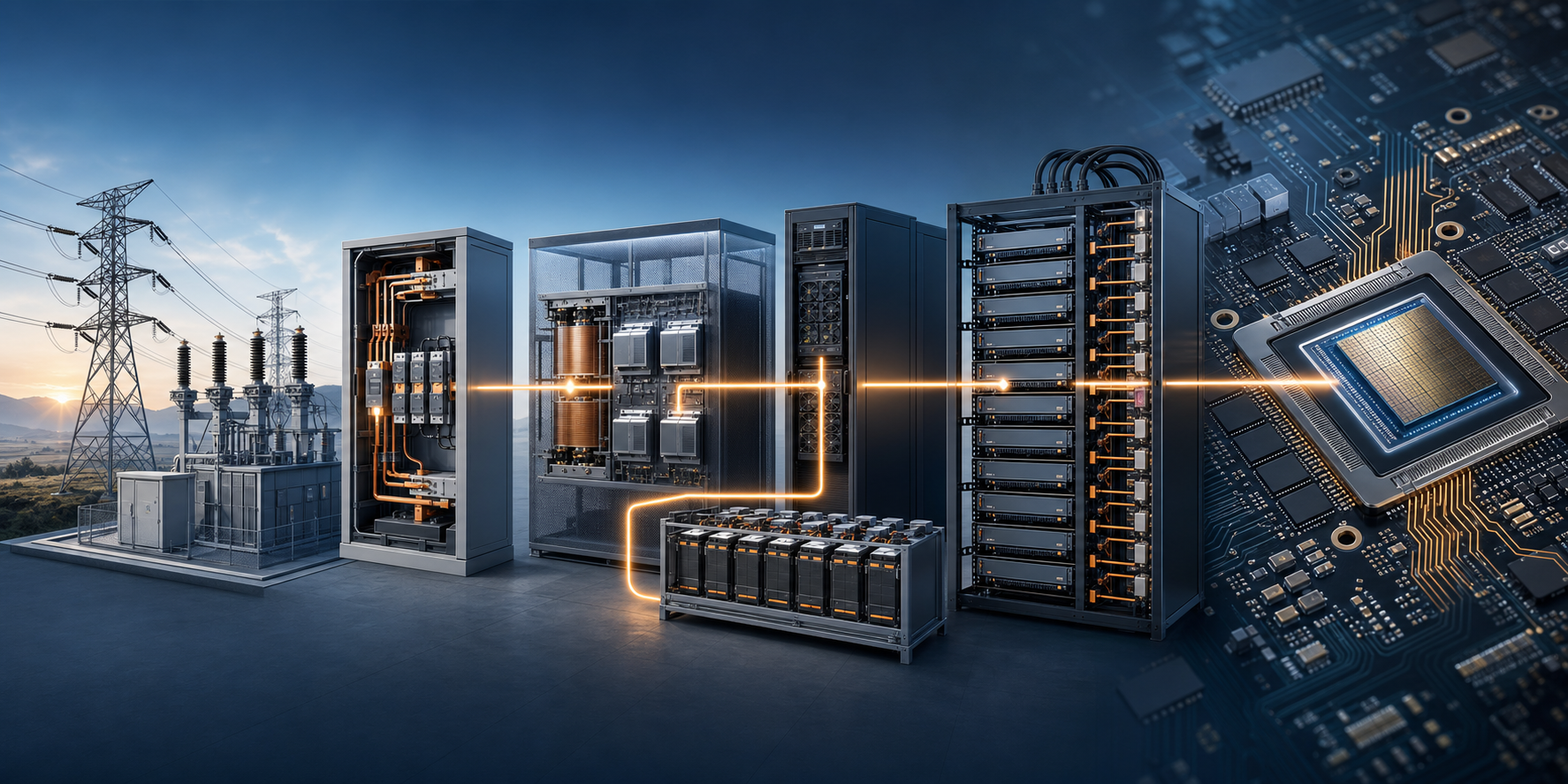
Infineon framed the AI data center problem from a different starting point: not the processor, not the rack, and not the power supply unit alone, but the full route from grid connection to processor core. The company called it a “From Grid to Core” view, and the framing matters because rack power is moving fast. The event materials described a shift from roughly 200 kW-class AI racks to about 500 kW today, with the next generation potentially moving toward 1 MW.
If that trajectory holds, power semiconductors move from supporting hardware to shaping the architecture around it.
The rack is pulling the power chain into one conversation
Infineon’s media-day message was built around one practical issue: AI compute density is rising faster than legacy power architectures were designed to absorb. A 500 kW or 1 MW rack changes the stress on every conversion stage — solid-state transformer (SST), uninterruptible power supply (UPS), battery backup unit (BBU), power supply unit (PSU), intermediate bus converter (IBC), voltage regulation module (VRM), and the final CPU/GPU power stage — well beyond simply carrying a larger load. Infineon’s public event release described a full-chain solution covering generation, transmission and distribution, storage, data center infrastructure, and physical AI applications such as EVs and robotics.
The more technical version is sharper: each conversion stage now becomes part of the AI performance envelope. That is why “grid to core” serves as a design principle: energy loss, dynamic response, footprint, thermal stress, and redundancy now need to be jointly optimized across every conversion stage. Cheng Jiayu, Senior Vice President of Infineon Technologies and Head of Industrial & Infrastructure Business Greater China.
Infineon’s restructuring turns portfolio breadth into a system argument
The company’s recent restructuring also points in this direction. From July 1, 2026, Infineon moved from four divisions to three: Automotive, Power Systems and Edge Systems. The official Media Day release positioned the change as a way to improve agility and accelerate system-level innovation.
For power customers, the logic is fairly direct. A data center power chain may use silicon MOSFETs, SiC, GaN, drivers, controllers, sensors, and protection devices in a single design. A customer buys efficiency, density, reliability, a stable supply, and a shorter development cycle, with the internal product-line map remaining invisible to them.
This is where Infineon is trying to turn portfolio breadth into a system argument. Cao Yanfei, Senior Vice President of Infineon Technologies and Head of Automotive Business Greater China. Source: Infineon.
The same pattern shows up outside AI data centers. In 2025, Infineon completed the acquisition of Marvell’s Automotive Ethernet business, strengthening its position in software-defined vehicles and adding high-bandwidth in-vehicle networking capability. In 2026, it announced the acquisition of ams OSRAM’s non-optical analog/mixed-signal sensor portfolio, adding sensor assets for automotive, industrial and medical markets.
On their own, these moves keep Infineon outside the data center business. Together, they point in the same direction of travel: control, power, sensing, connectivity, and safety are being integrated at the system level.
SiC and GaN are becoming placement decisions
The event also positioned the wide-bandgap discussion beyond a simple SiC-versus-GaN debate, a framing that matches how the two technologies are actually deployed. SiC is more naturally positioned in high-voltage, high-power, high-reliability stages: SST, DC microgrids, UPS and large front-end conversion. GaN is more compelling where high switching frequency, compact magnetics and high power density matter: data center PSUs, IBCs, robotics, solar inverters and onboard charging.
Silicon remains part of the stack because cost, maturity and scale still matter. Infineon has been explicit about this materials strategy. In 2024, the company announced 300 mm power GaN wafer technology, using existing 300 mm silicon manufacturing infrastructure as part of its longer-term GaN scaling roadmap.
At the same time, the company continues to position SiC as a key technology for high-efficiency energy conversion and power infrastructure. For system architects, the decision comes down to placement: where each material sits at the right voltage, frequency, thermal and reliability boundary.
China is becoming part of product definition
The other important thread from the Shanghai event was localization. Infineon’s “In China, for China” strategy is often easy to read as manufacturing localization. The Media Day suggested a broader shift: local production, local quality systems, local product definition, local innovation platforms and local operating infrastructure.
The production roadmap included 40 V MOSFET localization, 40 nm AURIX TC3x and 28 nm automotive radar sensor front-end and back-end localization plans, and DSO packaging scale-up for analog/mixed-signal products. The company also highlighted reliability testing and failure analysis capability in Wuxi, Shanghai Innovation Space, a robotics lab in Hong Kong, 19 innovation application centers, six system competence centers, and additional application labs. The strategic implication is straightforward.
China is becoming a place where product definition, system validation, and application learning occur earlier, extending its role well beyond that of an end market for power semiconductors. That matters for AI power, EVs, robotics and energy infrastructure because these markets are moving with local system requirements, local cost pressure and fast iteration cycles.
The capacity question is really an allocation question
David Poon, Senior Vice President of Infineon Technologies and President of Greater China. Source: Infineon. Infineon also linked AI data center demand to supply capability.
The company discussed its €5 billion smart power semiconductor fab in Dresden, scheduled to begin operation on July 2, and an additional €500 million investment in fiscal 2026 to expand capacity. It also referred to a “One Virtual Fab” model to improve supply-chain resilience and customer response. The AI numbers explain why this matters.
Infineon has publicly projected €2.5 billion in AI market revenue for fiscal 2027, supported by its position across the AI power delivery chain. The harder issue lies in allocation: how an IDM simultaneously allocates high-reliability power capacity among AI data centers, automotive, industrial infrastructure, and energy systems. Automotive and industrial customers care about long-term supply assurance, qualification stability, and quality consistency.
AI infrastructure is creating a faster growth curve. The tension is manageable only if manufacturing, portfolio planning, and customer engagement are treated as a single system.
Power semiconductor competition is moving up the stack
The most important message from Infineon’s 2026 Media Day was structural. Infineon connected automotive semiconductors, power devices, MCUs, sensors, Ethernet, SiC, GaN, data center power and China localization under one operating logic: system-level capability. For the next phase of power semiconductor competition, device parameters still matter.
Cost still matters. Supply still matters. But the differentiation is moving higher in the stack.
The companies that win the next AI power cycle may be the ones that can participate earlier in system definition, combine multiple semiconductor technologies into a single architecture, localize quickly enough for regional customers, and still guarantee reliability across long product lifecycles. Infineon’s bet is that “grid to core” marks the direction in which power semiconductor value is moving, extending well beyond a single data center story. Having sat through the full media-day agenda, I’d treat the three-division restructuring and the Dresden capacity build-out as the two signals worth watching over the next few quarters — they will show whether “grid to core” becomes an operating structure or remains a slogan.
Sources
[1] Infineon 2026 Media Day: Innovation Space officially opened Infineon / PR Newswire Asia, June 30, 2026
[2] Infineon successfully completes acquisition of Marvell’s Automotive Ethernet business, Infineon, August 14, 2025
[3] Infineon acquires non-optical analog/mixed-signal sensor portfolio from ams OSRAM, Infineon, February 3, 2026
[4] Infineon pioneers 300 mm power GaN technology, Infineon, September 11, 2024
[5] Infineon named as the Company to Beat in AI Data Center Power Semiconductors by Gartner, Infineon, June 26, 2026