

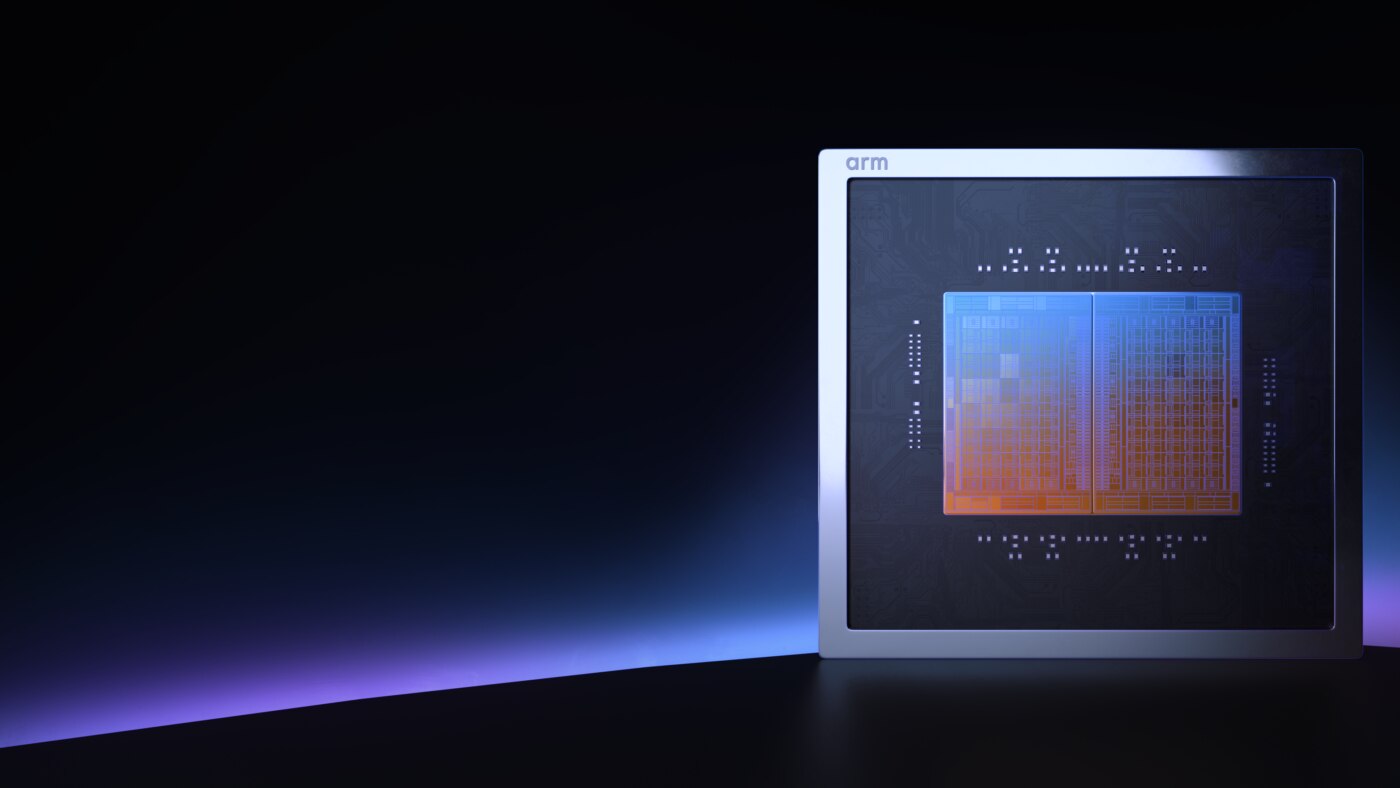
Arm Holdings has taken a historic strategic step by expanding its compute platform beyond IP licensing and compute subsystems into production silicon, introducing the new Arm AGI CPU—its first internally designed data-center processor targeting emerging agentic AI infrastructure.
For more than three decades, Arm’s architecture has enabled scalable and energy-efficient computing across billions of devices. With artificial intelligence changing what is needed for global infrastructure, the company is now adding complete silicon solutions to its platform strategy, in addition to its usual IP and Compute Subsystems (CSS) offerings. This move significantly broadens deployment flexibility for hyperscalers, cloud providers, and infrastructure partners building AI-optimized platforms.
The newly introduced Arm AGI CPU is designed specifically to address the rising computational demands generated by agentic AI workloads, where autonomous software agents continuously reason, plan, coordinate, and execute tasks across distributed environments. Unlike traditional AI training workloads dominated by accelerators, these systems increasingly rely on high-performance CPUs to manage orchestration, memory movement, scheduling, and token processing pipelines.
According to Arm, next-generation AI data centers may require over four times the current CPU capacity per gigawatt of deployed infrastructure. This shift is driving demand for CPUs capable of delivering deterministic performance under sustained workloads while remaining within strict power envelopes.
Built on Arm Neoverse V3 cores, the Arm AGI CPU integrates up to 136 cores per processor, delivering high memory bandwidth of approximately 6 GB/s per core with sub-100-nanosecond latency. The processor operates within a 300-W TDP envelope, enabling predictable performance through a dedicated core-per-thread architecture that eliminates idle thread inefficiencies and thermal throttling under continuous workloads.
At the rack level, the architecture enables substantial compute density improvements. Air-cooled deployments can support up to 8,160 cores per rack, while liquid-cooled systems scale beyond 45,000 cores per rack, providing more than 2× performance per rack compared with traditional x86 platforms. These gains translate directly into improved accelerator utilization and potentially significant reductions in AI infrastructure capital expenditure.
The Arm AGI CPU was developed in collaboration with Meta, which serves as the lead ecosystem partner. The processor is expected to integrate alongside Meta’s Meta Training and Inference Accelerator (MTIA) to support efficient orchestration across large-scale AI services. The partnership shows a growing trend of using different types of technology together, like CPUs, accelerators, and fast memory systems.
Additional ecosystem momentum includes support from companies such as Cloudflare, OpenAI, SAP, and SK Telecom, alongside infrastructure platforms from Lenovo, Supermicro, and Quanta Computer.
Manufactured using advanced 3-nm process technology by TSMC, the AGI CPU represents a major architectural milestone as Arm transitions from a pure IP provider to a silicon platform supplier supporting hyperscale AI deployments.
This evolution signals a structural shift in the data-center compute landscape. As agentic AI accelerates demand for scalable orchestration compute, Arm’s move into production silicon positions its architecture at the center of next-generation AI infrastructure spanning cloud, hyperscale, and enterprise deployments
