


The introduction of mercury arc valves in the early twentieth century marked a major technological breakthrough because of the wide range of industrial uses they enabled. Later, the emergence of power semiconductor components such as bipolar junction transistors (BJTs) significantly improved efficiency and performance across this market segment, while also helping reduce production costs for power electronic equipment. Over time, semiconductor-based power devices have continued to evolve, and recent progress now includes the integration of artificial intelligence (AI) across the broader power electronics ecosystem.
Today, power electronics plays a central role in nearly all industrial automation environments, supporting both energy generation and transmission processes. Applications such as renewable energy systems, high-voltage direct current (HVDC) transmission, flexible AC transmission networks, electric vehicles, and microgrid infrastructures all rely heavily on semiconductor power technologies. At the same time, ongoing industry transformation is driving the need for more advanced manufacturing techniques, smarter control strategies, and improved maintenance approaches for these devices. Because semiconductor power components typically operate at high switching frequencies, they introduce additional complexity in system control and management. Silicon Carbide (SiC) based JFETs and MOSFETs are one example. Artificial intelligence has proven to be an efficient method of designing, controlling, and sustaining power electrical systems.
AI and Power Electronics
Intelligence is no longer considered an exclusively human attribute. While Industry 3.0 introduced automation into manufacturing environments, it is the emergence of artificial intelligence (AI) and machine learning (ML) that has become a defining element of Industry 4.0. The objective of AI is to allow machines to replicate aspects of human reasoning and decision-making, with the added advantage that these systems can operate continuously without fatigue. Technologies such as facial recognition, autonomous driving systems, speech processing platforms, conversational chatbots, and many other applications are already benefiting from AI-driven capabilities.
Artificial intelligence offers particular advantages in the field of power electronics due to specific operational requirements, including fast parameter tuning and high sensitivity in condition monitoring. In practice, AI can support all three main stages of the power electronics lifecycle: system design, real-time control, and predictive maintenance.
At the same time, the rapid expansion of IoT infrastructures and Big Data analytics platforms has made large volumes of operational data available to train and improve AI models used throughout the lifecycle of power electronic systems.
This growing availability of structured and real-time data is creating strong momentum for the adoption of artificial intelligence within power electronics applications. By leveraging these datasets, AI techniques can enhance product competitiveness through global design optimization, intelligent control strategies, accurate health-state estimation, and other advanced functionalities. As a result, approaching power electronics research from a data-driven perspective is becoming increasingly valuable, particularly in complex and high-performance application scenarios.
AI in Power Electronics: Function and Methods
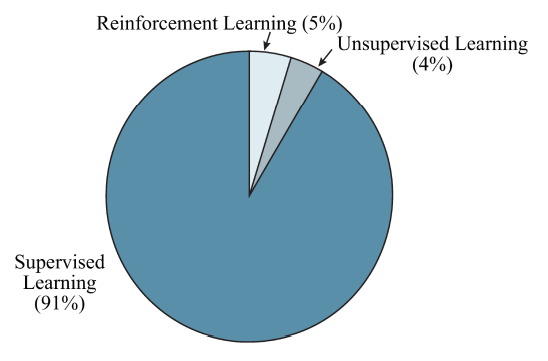
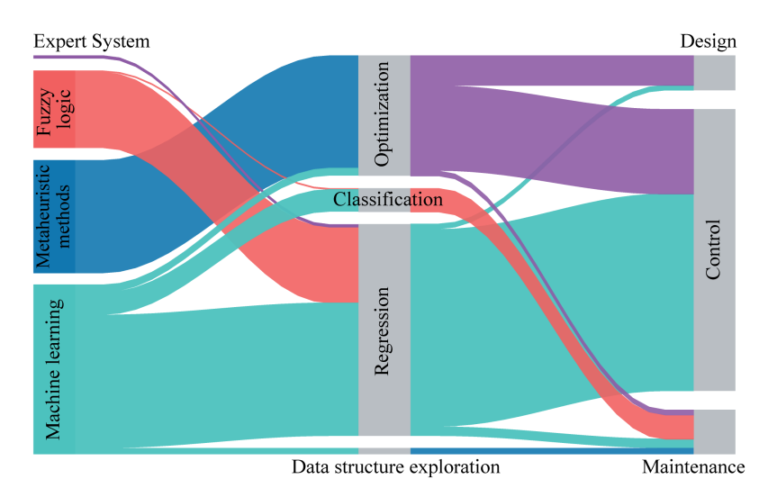
Within the power electronics domain, artificial intelligence is currently applied most extensively during the control stage, followed by maintenance activities, while its adoption in the design phase remains comparatively limited. The main AI functions used in these contexts can generally be grouped into optimization, classification, regression, and data-structure analysis tasks, with regression and optimization representing the majority of practical implementations. Among the most widely adopted artificial intelligence approaches in power electronics are expert systems, fuzzy logic techniques, metaheuristic algorithms, and machine learning methods. In particular, machine learning accounts for a significant share of current applications. For deployment in power electronics environments, ML techniques are typically categorized into supervised learning, unsupervised learning, and reinforcement learning.
At present, expert systems and fuzzy logic are applied less frequently—especially fuzzy logic approaches—but the increasing availability of more powerful computing platforms is enabling the adoption of increasingly advanced AI-based solutions. Metaheuristic optimization methods are also widely used in power electronics and continue to evolve over time. These techniques can operate either as standalone tools or in combination with machine learning algorithms to address complex optimization challenges. More recently, reinforcement learning (RL) has emerged as one of the most promising frontiers in machine learning for power electronics, supported by rapid progress in computing capabilities and processing performance.
AI’s potential in power electronics in the future
Despite extensive literature review and study on the potential application of AI in power electronics, it has yet to realize its full potential. Training AI models for deeper improved optimization requires deeper research and analysis.
There are various reasons why industries are hesitant to use AI. Some examples are:
1) Implementation complexity
2) Concerns about algorithm reliability and accuracy
3) Additional hardware costs
4) Significant computational energy usage
Another major challenge affecting the adoption of artificial intelligence in power electronics is the limited availability of large, high-quality datasets required for effective model training. Generating these datasets is often time-consuming, and the amount of data accessible for safety-critical applications is even more restricted. For this reason, there is a growing need to develop data-efficient AI approaches capable of delivering reliable performance even when only small training datasets are available.
Equally important is the development of transparent and interpretable AI algorithms that can increase confidence among engineers and industry professionals working in safety-sensitive environments. A clearer understanding of how these models operate enables designers to refine their behavior and adapt them more effectively to specific application requirements. As Industry 4.0 continues to advance toward highly autonomous and connected smart factories, artificial intelligence and machine learning are becoming central enabling technologies. Power electronics and AI together represent two highly influential technological domains with the potential to drive major industrial transformation. Although several challenges still need to be addressed to fully integrate AI into power electronics systems, continued research efforts are making this objective increasingly achievable.
References
[1] S. Zhao, F. Blaabjerg and H. Wang, ” An Overview of Artificial Intelligence Applications for
Power Electronics,” in IEEE Transactions on Power Electronics, vol. 36, no. 4, pp. 4633-4658,
April 2021, doi: 10.1109/TPEL.2020.3024914.
