


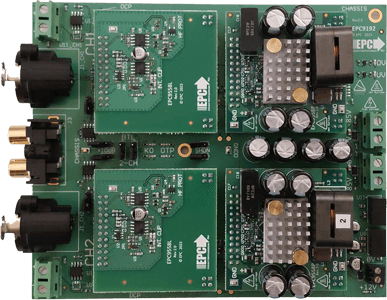
The professional audio sector traditionally adopts new semiconductor technologies cautiously, mainly due to strict requirements on reliability, predictable lifetime behavior, and continuous operation stability. However, gallium nitride (GaN) transistors are increasingly being introduced into Class-D amplifier output stages because of their switching performance advantages and efficiency improvements. Since 2020, early implementations in professional multi-channel amplifier platforms have demonstrated that GaN devices can be integrated without major architectural changes while enabling measurable gains in system-level performance.
Device Selection for Medium-Power Audio Channels
Initial GaN-based amplifier platforms targeted power levels between approximately 50 W and 300 W per channel, typically operating with supply rails near ±60 V. In this operating range, 150 V enhancement-mode GaN FETs provide sufficient voltage margin while maintaining low switching losses and compact layout capability.
Compared with silicon MOSFETs traditionally used in Class-D stages, GaN devices offer reduced output capacitance, lower gate charge, and negligible reverse-recovery charge. These properties directly improve switching transitions without requiring fundamental topology modifications. As a result, early adoption primarily involved replacing the switching devices while preserving established modulator and control architectures.
An important practical aspect in early qualification phases was the availability of publicly accessible reliability and application data. This supported accelerated validation cycles and reduced uncertainty typically associated with introducing new power semiconductor technologies into long-lifecycle professional systems ⚙️.
Switching Behavior and Distortion Mechanisms
In Class-D amplifiers, distortion performance is strongly influenced by switching characteristics rather than static conduction behavior. Faster transitions allow shorter dead times and reduced nonlinearities associated with body-diode recovery and propagation delays.
Key GaN parameters relevant to audio output stages include:
- reduced gate charge for equivalent on-resistance
- very low reverse-recovery charge
- reduced output capacitance
- short switching transition times
- minimized package parasitic inductance
Together, these characteristics enable operation at higher switching frequencies and improve linearity under dynamic signal conditions. Reference implementations using GaN devices have demonstrated THD+N values below 0.005% and signal-to-noise ratios above 120 dB, confirming suitability for high-fidelity professional amplification environments.
Optimization for Real Audio Signal Profiles
Unlike many industrial power conversion applications, audio amplification is characterized by signals with high crest factor. This means peak currents occur intermittently, while average current remains comparatively low. Consequently, switching losses dominate thermal behavior more than conduction losses in many practical amplifier channels.
Device selection therefore, prioritizes switching performance rather than minimum RDS(on). This approach improves efficiency under realistic operating conditions and contributes to reduced thermal stress at the system level.
Switching edge control is another critical design parameter. Excessively fast voltage transitions can couple into analog modulator circuitry and degrade noise performance. Controlled adjustment of gate resistance allows optimization of dv/dt while maintaining acceptable switching efficiency. Similarly, conservative dead-time tuning reduces idle power consumption—an important consideration in installations operating continuously for long periods.
Packaging and Assembly Considerations
Early chip-scale GaN devices provided excellent electrical performance but required careful PCB handling and assembly control. Later migration toward QFN-packaged devices improved mechanical robustness and manufacturability while preserving low parasitic inductance.
Assembly process optimization proved essential during early prototyping stages. In particular, stencil aperture geometry and solder volume control significantly influenced joint reliability. Once these parameters were stabilized, thermal cycling and overload testing confirmed expected device robustness and repeatable long-term behavior.
High-Density Multi-Channel Integration
One of the most significant advantages of GaN technology in professional audio systems is improved power density. Modern amplifier platforms can integrate up to 32 channels within a single 1U chassis while maintaining idle power consumption below 100 W.
Reduced switching losses directly translate into lower thermal dissipation, which simplifies cooling system requirements and increases operational stability in constrained installation environments such as theater racks, touring systems, and marine audio infrastructures.
Lower heat generation also contributes to improved long-term reliability by reducing temperature gradients across densely populated amplifier modules.
Reliability and Field Deployment Experience
Initial reliability deviations observed during early development were primarily related to assembly process variations rather than intrinsic device limitations. After optimization of soldering parameters and layout implementation, long-term operation aligned with published GaN reliability expectations.
Large-scale deployment of GaN-based amplifier channels in professional installations has confirmed stable field behavior over extended operating periods. Accelerated stress testing and operational feedback indicate no systematic device-level failure mechanisms linked to the GaN switching elements themselves.
Extension Toward System-Level GaN Architectures
Current development trends extend GaN adoption beyond output stages toward auxiliary power conversion functions, including resonant LLC converters and multi-level PFC front ends. Using a common semiconductor technology across both amplification and power supply subsystems enables further improvements in efficiency, integration density, and thermal management consistency across the complete amplifier platform.
Overall, GaN integration in professional audio does not primarily target audible distortion improvements alone. Instead, the most significant benefits emerge at system level: reduced enclosure size, improved thermal behavior, higher channel density, and simplified cooling infrastructure—factors that directly support reliable operation in demanding professional environments.
