


As a game-changing technology, quantum computing (QC) did not take root suddenly. Its idea came about in the early 1980s, thanks to physicists like Nobel laureate Richard Feynman and David Deutsch. They questioned whether classical digital computers could accurately simulate the complex quantum world. Their reasoning revolved around a subtle observation: if reality at its fundamental level conforms to quantum mechanics, perhaps computation itself should logically adhere to the same physical rules. This analogy led to quantum bits, or qubits, which, unlike classical two-state binary digits, can manifest in superpositions and become intimately correlated through non-local entanglement.
At the beginning of the 2000s, key theoretical milestones such as Shor’s algorithm for factoring large integer numbers and Grover’s search algorithm had confirmed that quantum computers could outpace classical systems on particular tasks. However, building a practical quantum computer has proven far more difficult than designing algorithms for one. Upon interacting with the environment, intrinsically fragile qubits lose their quantum states and are highly susceptible to noise.
More recently, the discipline has entered the so-called Noisy Intermediate-Scale Quantum (NISQ) era. Contemporary quantum processors, developed by leading companies and research labs worldwide, can function with tens to hundreds of qubits. These machines have achieved important milestones, including demonstrations of “quantum advantage”—a tailored benchmark designed to highlight performance on carefully defined problems. Yet, quantum computers have not reached the scale and error resilience for solving important, real-world problems.
Obstacles still persist, though: decoherence, a phenomenon triggered by environmental interactions, degrades their fragile quantum states.
Sophisticated error correction techniques have been developed to minimize error rates. However, these schemes lead to a drastic increase in the number of physical qubits to reliably encode logical qubits. Additionally, scaling hardware while maintaining stability and connectivity is a highly demanding engineering task.
With all these challenges in view, a dilemma has intrigued researchers: can we leverage QC potential benefits today, or shall we wait many years for the technology to reach full maturity? If “in medio stat virtus” remains a universally balanced approach, then the answer lies in hybrid quantum-classical computing—an architecture that blends the merits of quantum processors with the reliability and ease of scalability of classical computers.
Hybrid quantum-classical computing
Hybrid quantum-classical computing identifies a class of computational processes in which quantum and classical processors interact and strengthen one another to solve problems. Rather than relying on a purely quantum approach, workloads are partitioned so that each system handles the tasks that it’s natively optimized for.
Classical computers excel at deterministic logic—meaning the same input always produces exactly the same output—big data processing and fault-tolerant computations. Conversely, quantum computers are well-suited to tasks involving probability distributions, such as simulating quantum systems and solving specific optimization problems.
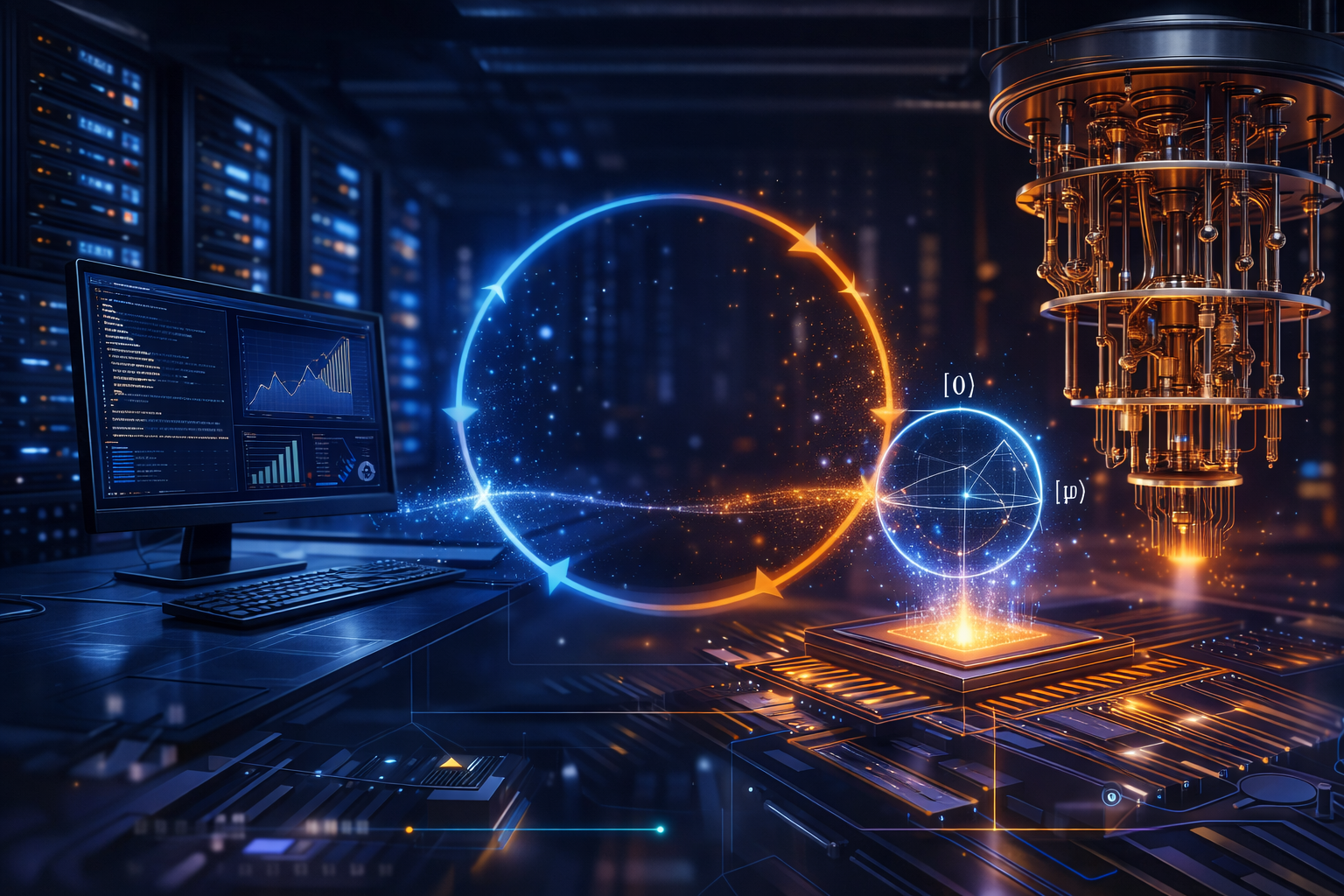
In a hybrid architecture, the computation is orchestrated by a classical system. It sets up inputs, transfers specific subtasks to a quantum processor, monitors measurement results, and iteratively refines the solution. This feedback loop allows efficient use of quantum resources while overcoming their current limitations.
Why hybrid is effective as near-term approach
The hybrid model is not just a contingency measure—it’s a must in the NISQ era. Fully quantum solutions require deep circuits and low error rates, both of which are currently out of reach. Hybrid approaches reduce circuit depth and make algorithms more resilient to noise.
One of the key advantages is flexibility. Classical optimization algorithms can guide quantum gates toward better solutions, even when quantum hardware is far from perfect. This makes hybrid routines particularly suitable for emerging applications.
Moreover, hybrid systems leverage existing platforms. Instead of substituting classical supercomputers, quantum processors are embedded as specialized accelerators, pretty similar to how GPUs are deployed today in AI workloads.
Hybrid algorithms
Several hybrid algorithms have been proposed as leading candidates for practical applications.
In Variational Quantum Eigensolver (VQE), a method largely used in materials science and quantum chemistry, a quantum processor generates candidate quantum states that model a molecule, each defined by a set of adjustable parameters. A classical optimizer then assesses each candidate by estimating its energy and tunes the parameters to improve the result. By repeating this process iteratively, the system converges toward the lowest-energy configuration—the ground state—which enables researchers to predict most of the molecule’s properties that are difficult to simulate classically.
Like VQE, Quantum Approximate Optimization Algorithm (QAOA)— addressing combinatorial optimization problems such as scheduling, routing, and portfolio optimization—uses a parameterized quantum circuit guided by classical optimization. Although still experimental, QAOA has shown promise in tackling problems with complex solution spaces.
Other algorithms exploit Hybrid Machine Learning Models. Quantum-enabled machine learning merges traditional neural networks with quantum layers. These models aim to sharpen feature representation and enhance optimization processes, potentially yielding a measurable edge in specific domains.
Some real-world applications
While hybrid quantum-classical computing is still in a development stage, some sectors are fruitfully pursuing its potential.
Classical systems falter in simulating molecular interactions, limited by exponential scaling. Hybrid quantum algorithms like VQE are being used to study molecular structures and model chemical reactions, effectively accelerating the discovery of new drugs and materials.
In banking and asset management, operators are exploring hybrid approaches for portfolio optimization, risk analysis, and fraud prevention. These problems often rely on complex optimization strategies that could leverage quantum-enhanced techniques.
Routing and scheduling problems are proverbially difficult to optimize. Hybrid quantum algorithms offer new ways to navigate large solution spaces, potentially improving efficiency in transportation, distribution, and supply chain management.
Energy and climate modeling
Quantum systems can simulate physical processes at a fundamental level, supporting advances in materials for green energy. Meanwhile, hybrid approaches are being explored to optimize power flow in electrical grids, and modeling complex climate dynamics.
Architecture of a typical hybrid system
Hybrid quantum-classical systems typically consist of the following components:
- Classical Controller
This is the main processor that directs the workflow, executes optimization algorithms, and processes results. - Quantum Processing Unit (QPU)
The QPU runs quantum circuits, returning measurement outcomes. It behaves as a co-processor. - Communication Interface
Data must consistently be dispatched between classical and quantum systems. Latency and bandwidth are key factors impacting performance. - Software Stack
Frameworks and programming languages help developers to design hybrid algorithms, optimize resources, and integrate workflows.
Challenges of the hybrid approach
Despite showing promising results, hybrid quantum-classical systems have inherent shortfalls, namely related to noise and error rates. Even basic quantum circuits are affected by noise. This can produce incorrect results and unstable optimization processes.
A significant hurdle in hybrid approaches arises when classical optimizers converge on local minima—suboptimal solutions the algorithm gets trapped in—rather than the global optimum.
Moreover, as the scale of the problem increases, synchronizing data between classical and quantum hardware creates a latency bottleneck that can reduce the quantum speedup.
Hardware constraints
Fewer logical qubits, connectivity, and coherence times restrict the group of problems that can be tackled. Frequent data transfer between classical and quantum systems can introduce latency and reduce overall efficiency.
Short- and long-term future
Rather than being a temporary solution, hybrid quantum-classical computing could be a viable long-term framework. Fully operational quantum systems may eventually handle certain tasks independently, but many real-world problems will likely continue to take advantage from a division of functions.
This reflects the evolution of classical computing itself. Modern computing systems are intrinsically hybrid, combining CPUs, GPUs, and specialized accelerators. Quantum processors may simply be another building block to integrate in this multimodal ecosystem.
Furthermore, hybridization provides a route for gradual adoption. Research labs and business organizations can begin experimenting with quantum computing today without redesigning their global infrastructure. This lowers the entry barrier while accelerating innovation.
Looking ahead, further refinements are expected to drive the evolution of hybrid computing.
Improvements in qubit quality, coherence times, and connectivity will enlarge the domain of target applications. New hybrid algorithms will be developed to overcome current limitations and unlock practical advantages.
Enhanced software tools and user-friendly frameworks will make it easier for developers to build and deploy hybrid applications.
Integration with cloud platforms will enable quantum processors to be increasingly accessible via the cloud, a big advantage for the technical community.
As these elements combine, hybrid systems will likely play a unique role in the transition from experimental quantum computing to real-world impact.
Key takeaway
QC has pivoted from being an abstract physical theory with solid theoretical foundations to being a real-world experiment—a significant leap in data processing. While big challenges remain—such as error correction and scalability—the field is consistently advancing.
Hybrid quantum-classical architectures embody the most pragmatic path forward. By bringing together the best parts of both paradigms, they open the door to future breakthroughs.
Rather than waiting for perfectly designed quantum machines, the hybrid approach allows engineers to solve problems now. In doing so, QC emerges not as a replacement for classical systems, but as a powerful companion.
One thing is clear: the future of computing, at least for the foreseeable future, will not be all classical or all quantum. To get the most out of each of them, they will have to work together in a coordinated manner.