


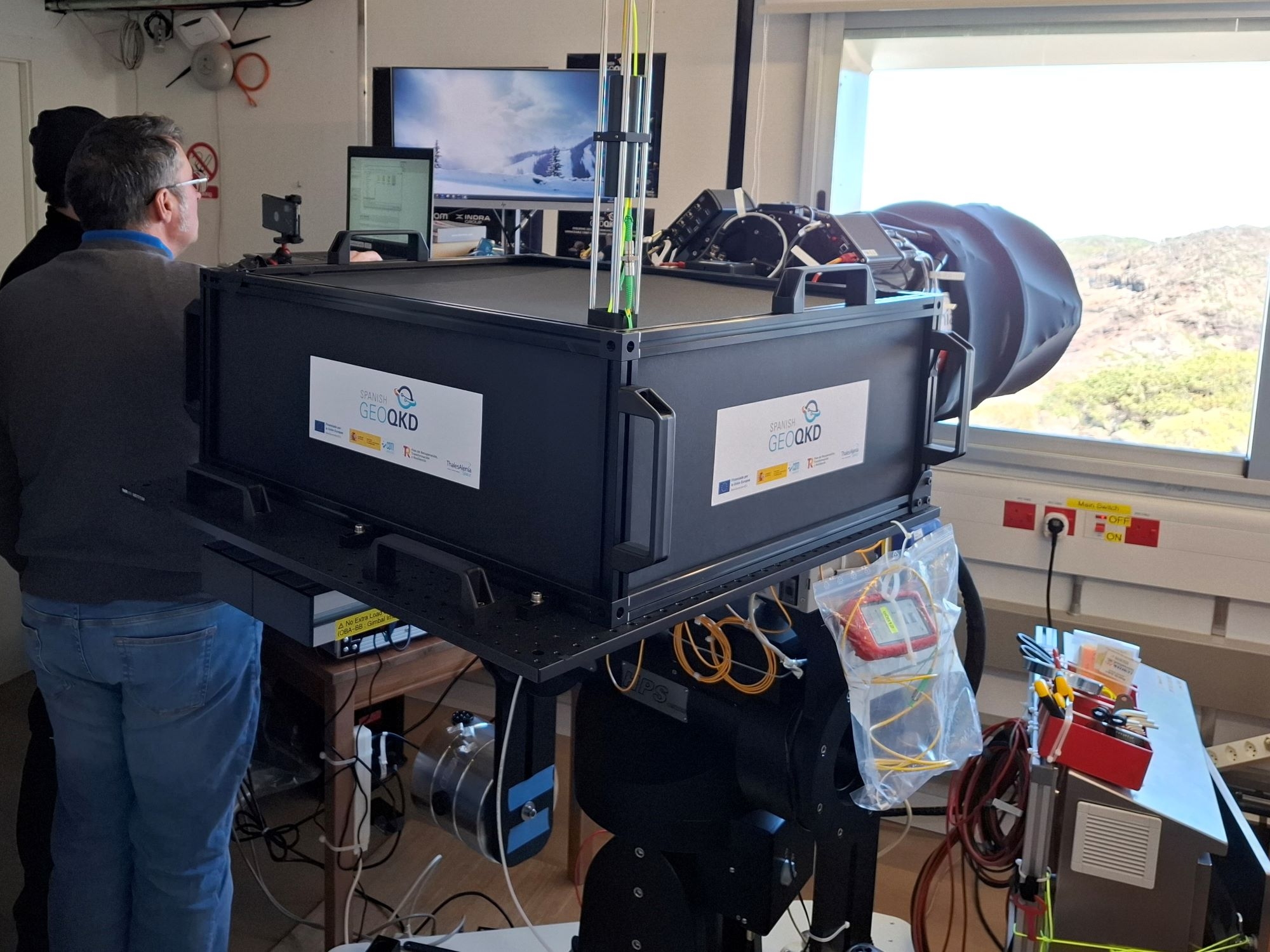
Thales Alenia Space and its project partners have successfully completed a high-precision quantum communication transmission between the Canary Islands of La Palma and Tenerife as part of the Spanish GEO QKD initiative. The achievement represents a major milestone in the development of Europe’s future space-based quantum key distribution (QKD) infrastructure.
The GEO QKD project aims to develop the first quantum key distribution system operating from geostationary orbit. The recent field tests were designed to validate the technology in a real-world environment before deployment aboard a satellite.
The demonstration used an engineering model replicating both the satellite payload and the associated ground segment. The QKD payload was installed at the Roque de los Muchachos Observatory, while the terrestrial optical receiver was located at the Teide Observatory.
During the tests, the teams successfully transmitted quantum key distribution signals consisting of individual photons through free space over a distance of approximately 140 km under atmospheric turbulence. The transmitted signal was then injected into a single-mode optical fiber measuring only 10 microns in diameter. According to the project participants, this level of precision in free-space quantum transmission had not been demonstrated before.
The project team reported successful completion of all major operational phases, including calibration, synchronization, and photon transmission protocols. The results demonstrated the system’s stability and robustness and confirmed the practical feasibility of long-distance quantum communication technologies for future satellite deployment.
Over the coming months, the consortium plans to continue testing and refining the system in the Canary Islands to further validate performance and prepare for future space-based implementation. The project is intended to contribute to Europe’s digital sovereignty by enabling a highly secure quantum-encrypted communications infrastructure.
The GEO QKD initiative is supported by the Spanish State Secretariat for Telecommunications and Digital Infrastructure, managed by the Center for Technological Development and Innovation (CDTI), and funded through European Union recovery programs under the PERTE Aeroespacial initiative.
