



Every EV platform team faces a version of the same spreadsheet problem: cover compact cars at ~80 kW and performance vehicles above 400 kW, across 400 V and 800 V architectures, with as few hardware variants as possible. The traction inverter sits at the center of that spreadsheet. And the power module inside the inverter is the component that determines how many rows it actually has.
Bosch just made that calculation more explicit. The company published detailed technical positioning for two distinct SiC power module families — PM6 and DSL — designed for the same traction inverter market but optimized for fundamentally different scaling strategies.
PM6 packs up to twelve SiC chips into a single half-bridge package; DSL keeps just two chips per module and lets the system integrator decide how many to parallel. The fact that Bosch ships both tells you something about where the inverter design conversation has moved.
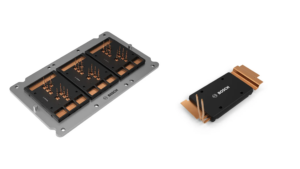
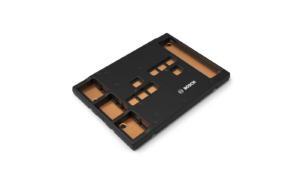
PM6 is Bosch’s answer for the mainstream high-voltage traction inverter. Each module forms a half bridge with two topological switch positions. Three PM6 modules make a complete three-phase B6 bridge, covering roughly 80 kW to over 400 kW.
The scaling happens inside the package. Depending on the power target, a PM6 module can integrate four, eight, or twelve SiC MOSFET chips, with die sizes up to 40 mm² each. Per topological switch, that means two, four, or six chips in parallel. An OEM designing a compact EV and a performance SUV on the same inverter platform can use the same module footprint with different chip populations.
This matters because Bosch positions PM6 scaling inside the module rather than through multiple external modules in parallel, reducing the number of platform variants and the related development burden. For platform teams managing several vehicle variants, that points to fewer hardware variants, reduced development effort, and easier production scaling.
The thermal and electrical design reinforces the platform logic. Silicon nitride (Si₃N₄) ceramic substrates handle both heat extraction and thermal cycling stress. A symmetrical internal layout suppresses stray inductance and voltage overshoot — the two parameters that most directly limit how fast you can switch SiC MOSFETs in practice. Bosch’s PM6 materials also state that the platform supports both open pin-fin and closed strip-fin coolers, in aluminum or copper, depending on the required performance. The module accommodates the cooling architecture rather than dictating it.
DSL: more modules, more topological freedom
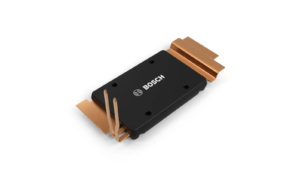
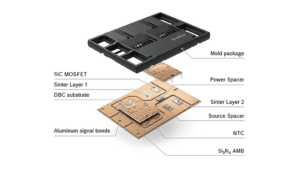
DSL takes the opposite approach. Each module contains just two parallel SiC MOSFETs — a single switch element. A basic B6 bridge needs six DSL modules. Higher power? Parallel two per position (twelve total), three (eighteen), or four (twenty-four).
The design point is flexibility. DSL modules can populate conventional B6 topologies, but they also fit multilevel circuits and other architectures where the switching building block needs to be smaller than a half bridge. For OEMs exploring topologies beyond standard three-phase bridges — and several are, especially for 800 V and future 1200 V systems — DSL provides a way to prototype and validate without committing to a custom module.
There is a practical consideration as well. Smaller or more space-constrained applications — including two-wheelers and other individually designed high-voltage functions — may only need the power of a single DSL per switch position. The module’s compact form factor accommodates constrained installation spaces that a PM6 physically cannot fit into.
Two customer camps split on inverter architecture — Bosch ships a product for each
Bosch could have designed one module family with a wider scaling range. The decision to maintain two lines reflects a structural reality in the inverter market: OEMs do not agree on how to build traction inverters.
Some vehicle manufacturers are committed to conventional B6 architectures and want the fewest possible part numbers across their entire EV lineup — exactly the consolidation logic PM6 was designed around. Others are investing in advanced topologies — multilevel, modular, or application-specific — where the power module needs to be a building block rather than a pre-integrated subsystem, and DSL gives them that granularity.
Trying to force both use cases into a single module family would mean compromising either power density or topological flexibility. Bosch’s two-line approach accepts that the traction inverter market is diverging, and positions a product for each branch.
Gen 3 SiC chips and the Fuji Electric dual-source deal
The module portfolio connects to two other layers of Bosch’s SiC strategy that are easy to overlook.
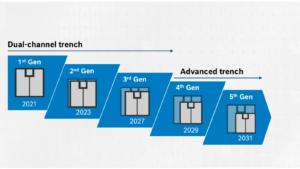
First, the chip roadmap. Bosch recently introduced its third-generation SiC trench MOSFETs, with samples already shipping to global automakers. Each chip generation feeds directly into the module platform: better specific on-resistance means fewer chips per switch position for the same current rating, which means either smaller modules or higher power in the same footprint.
Second, the Fuji Electric collaboration. Announced in late 2025, the partnership targets mechanical package compatibility — matching outer dimensions and terminal positions between Bosch and Fuji Electric SiC modules. For OEMs, that creates a dual-source option at the module level with significantly reduced mechanical adaptation effort — a meaningful risk-reduction path once both options pass the required automotive qualification work.
Bosch’s global production network — spanning Europe, Asia, and the Americas — supports a local-for-local supply model. For automotive programs, that geographic diversification strengthens the supply-chain argument around the module portfolio.
Three open variables for next-generation platform decisions
Three questions will determine whether PM6 and DSL actually change how a traction inverter program runs.
Chip generation cadence. Bosch’s Gen 3 SiC MOSFETs are sampling now. How quickly those devices move into PM6 and DSL production modules — and what that does to the power-per-footprint curve — directly affects platform planning for 2028–2030 vehicle programs.
Fuji Electric interchangeability timeline. The collaboration is announced but the timeline for qualified, interchangeable modules has not been disclosed. Until dual-source modules pass automotive qualification in parallel, the supply chain benefit remains a design intent.
Topology adoption rate. DSL’s value proposition scales with how many OEMs actually move beyond B6. Should the industry stay on standard three-phase bridges for the next decade, DSL remains a specialist option. The calculus reverses once multilevel or modular topologies gain real traction at 800 V and above — at that point, DSL’s per-switch granularity could make it the more strategically important line.
The power module used to be the part of the inverter you specified last. Bosch is betting it becomes the part you specify first.
Sources:
- Power Modules for the Next Chapter of Electromobility, Bosch Semiconductors, April 2026
- Power Modules: Driving Efficiency in Inverter Solutions, Bosch Semiconductors
- Power Modules on Cooler for Inverters, Bosch Mobility
- Bosch’s Response to E-Mobility Ramp Up: PM6 — PCIM 2025, PCIM Europe
- Bosch and Fuji Electric Create Dual-Source Opportunity, Bosch Semiconductors
- Expert Perspective: Sebastian Strache on Power Module Applications, Bosch Semiconductors